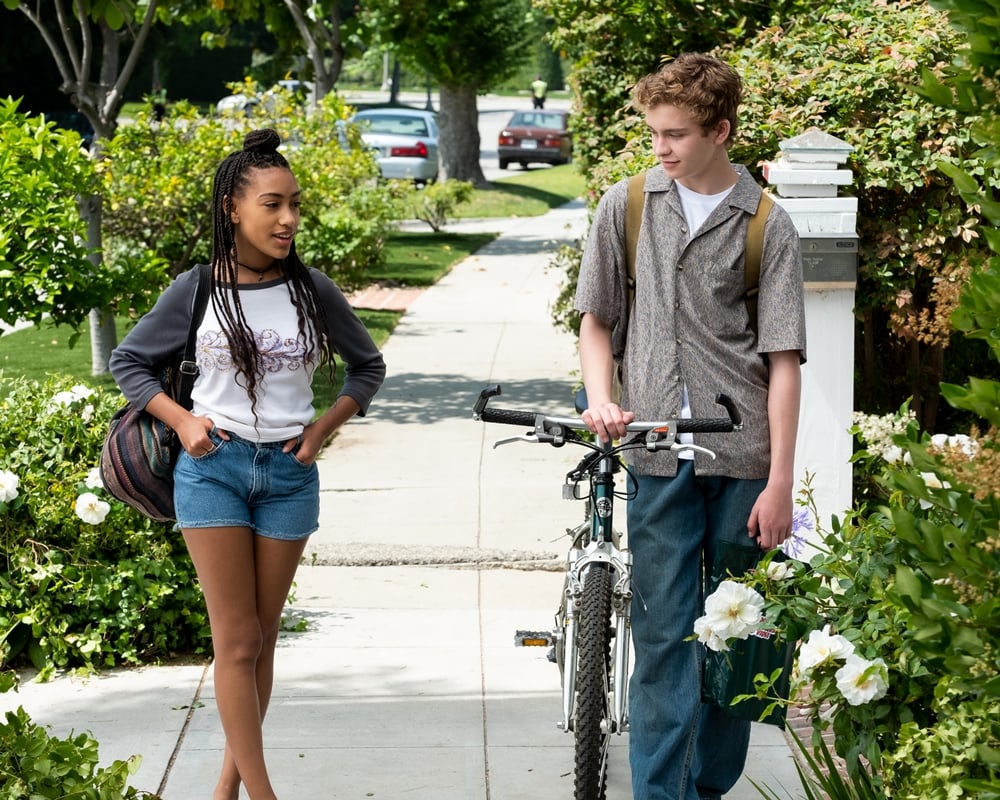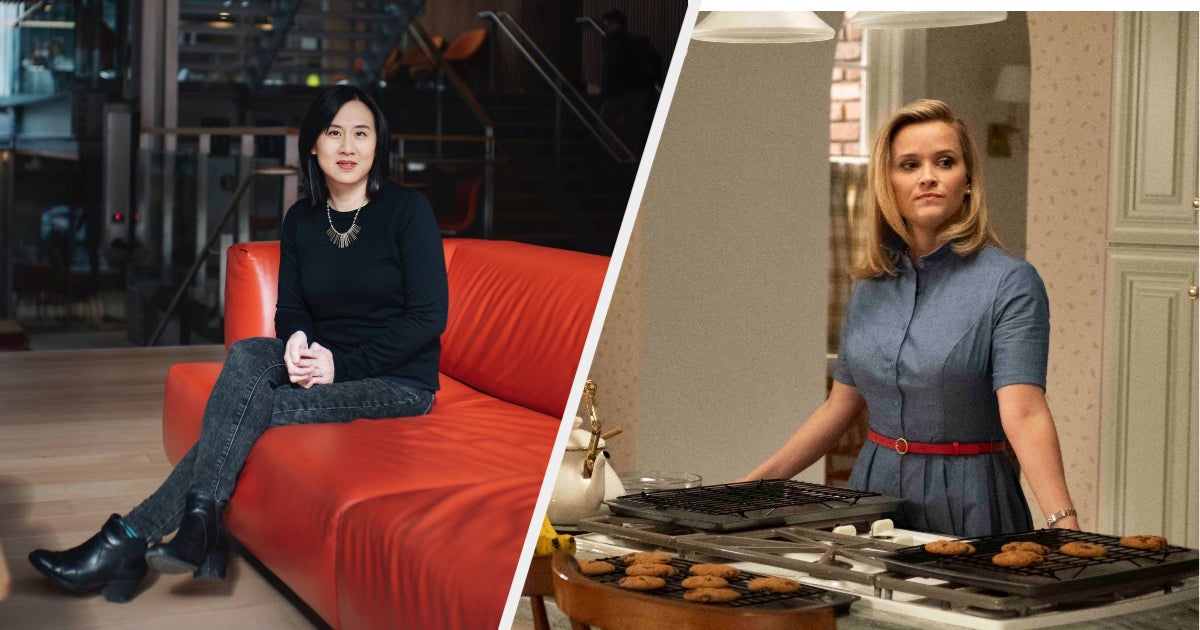
Author Celeste Ng photographed in Cambridge, Massachusetts.
From time to time, all of us find ourselves using the same word, over and over again, to describe the world around us. For Celeste Ng, in the spring of 2020, that word is complicated. A woman adopting a baby from China because of her own infertility? Complicated. The same word applies for the ads on the back page of the alt-weekly newspaper she used to read when she was a Harvard college student, offering tens of thousands of dollars for women with specific attributes and SAT scores to serve as egg donors and surrogates. “I was working jobs that paid $10 an hour,” Ng told me. “And you do think about it. It’s so complicated! I would totally understand why someone would do that, and I can understand why someone would want that so much.”
Other things that are complicated: the racial makeup of the town where she grew up (Shaker Heights, Ohio), which is actually far less white than most people assume; surrogacy law in the state of New Jersey and how it affects queer couples; what to do with well-meaning white ladies; and figuring out how to eat a plate of “messy fries” while answering interview questions.
Ng was attempting to manage those fries at a bar off Harvard Square in Cambridge late February — a place she used to go, back when she was a student, because the service was terrible, which meant you could sit for hours, nursing a beer or a cup of coffee, and study. Now, the bar is in new hands, the food is very good, and the service is incredibly attentive — and Ng was mostly trying to talk as much as she could, while eating as much food as she could from the four plates she ordered for the table, because she didn’t want to offend the chef.
Ng, age 39, is also a self-described type A people-pleaser, which she attributes to her upbringing in Shaker Heights. “I do my homework,” she told me several times over the course of the interview.
Ng knows she’s incredibly lucky. She’s written two books and both have been massive bestsellers: According to BookScan data, Everything I Never Told You, released in 2014, has sold 67,000 units in hardcover and around 475,000 in paperback; Little Fires Everywhere has spent 47 weeks on the New York Times’ bestseller list and has sold nearly 500,000 units in hardcover and 410,000 in paperback, and is currently No. 1 on the paperback list. If you’re not in the book industry, let me make it clear: These are astonishing sales numbers.
A film adaptation of Everything I Never Told You is in the works; Julia Roberts was once attached. The adaptation of her bestselling novel, Little Fires Everywhere, starring Reese Witherspoon and Kerry Washington is now streaming on Hulu. And along with Witherspoon and Washington, she’s a producer on the show. Ng’s been able to work slowly on her early thoughts for the next book, without worrying about money or trying to write the sort of book that she can convince an editor to take a chance on. She’s a known and reliable brand — the best place to be in the book world.
Between bites of fry, Ng tried to describe just how thoroughly she prepared for her cameo in Little Fires. “I’m curious who will spot me,” she said. (Spoiler: It involves a book club.) “I just love that they asked me to do it, because I had this hard sell about why I wanted to, and that I was happy to just be a waitress in the background, and I could definitely do it, definitely pretend. But before I even asked, they offered. And so, before I got on set, I got a book called Setlife, by this person who worked his way up to be the first assistant director on a set. I wanted to know what was going on; I’m just generally interested in how people do their jobs. But when I was in LA to go on set, my husband and son were with me, and we were by the pool at the hotel — they were splashing around, while I was there rereading the book, checking the difference between the first and second director.”
“My husband was just laughing at me,” Ng said. “Like, ‘Are you having fun doing your homework at the pool?’” But Ng was vindicated: When she got to set, they gave her a call sheet, and she knew every code on it. When they set “we’re resetting to 1,” she knew what they were talking about. “I felt so smart,” she said. “But again, this is the Shaker Heights personality.”
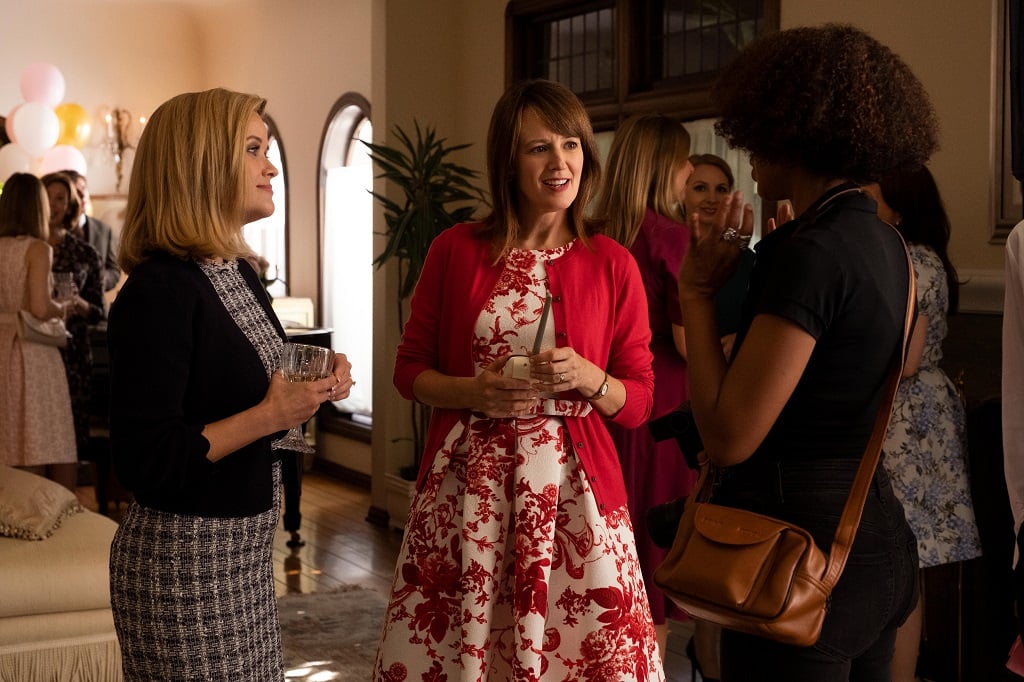
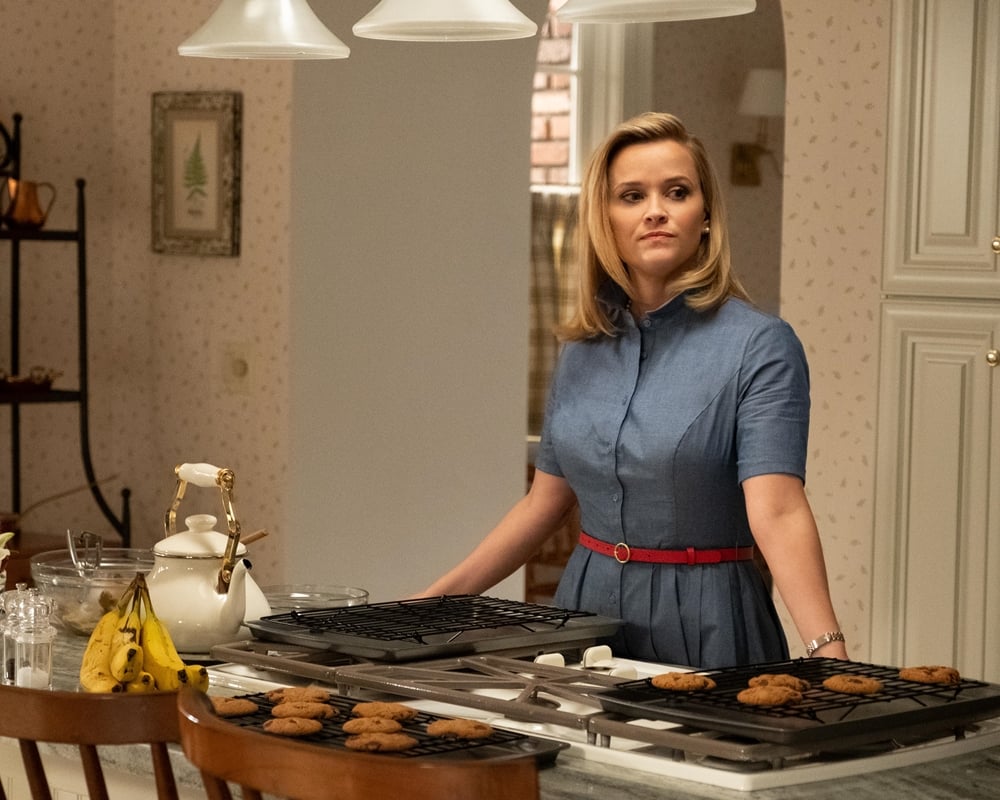
Reese Witherspoon in Little Fires Everywhere.
There’s something about Shaker Heights that fascinates people. At least there is when it’s Ng doing the describing. Little Fires Everywhere starts with a description of the arson that gives the book its title, but it’s the second chapter, and its explanation of the “rules, many rules, about what you could and could not do,” that lassoes the reader. There’s the city’s actual motto — “Most communities just happen; the best are planned” — and the corresponding philosophy that “everything could — and should be — planned out, and that by doing so you could avoid the unseemly, the unpleasant, and the disastrous.” There’s something deeply fascinating about a community that believes it can protect itself from discrimination and inequity by regulating that all duplexes should look like single-family homes from the front, so as to eliminate the “stigma” of renting.
From the start, Ng conceived of one of her protagonists — Elena Richardson, a mother of four and the type of person to have exactly 4 ounces of wine every night — as the perfect embodiment of the larger Shaker Heights philosophy: that, with enough planning, and organization, and good intentions, you could solve pretty much every problem. It made sense, then, when the news emerged that Reese Witherspoon’s production company, Hello Sunshine, had optioned the rights to Little Fires before the book had even come out: The Witherspoon image, accumulated through roles in Legally Blonde, Election, and Sweet Home Alabama, is that of a character with the utmost confidence in the benefits of planning. These iconic Witherspoon characters have perfect hair, coordinated outfits, and color-coded planners. They are also deeply sad, deeply dysfunctional, or deeply underestimated.
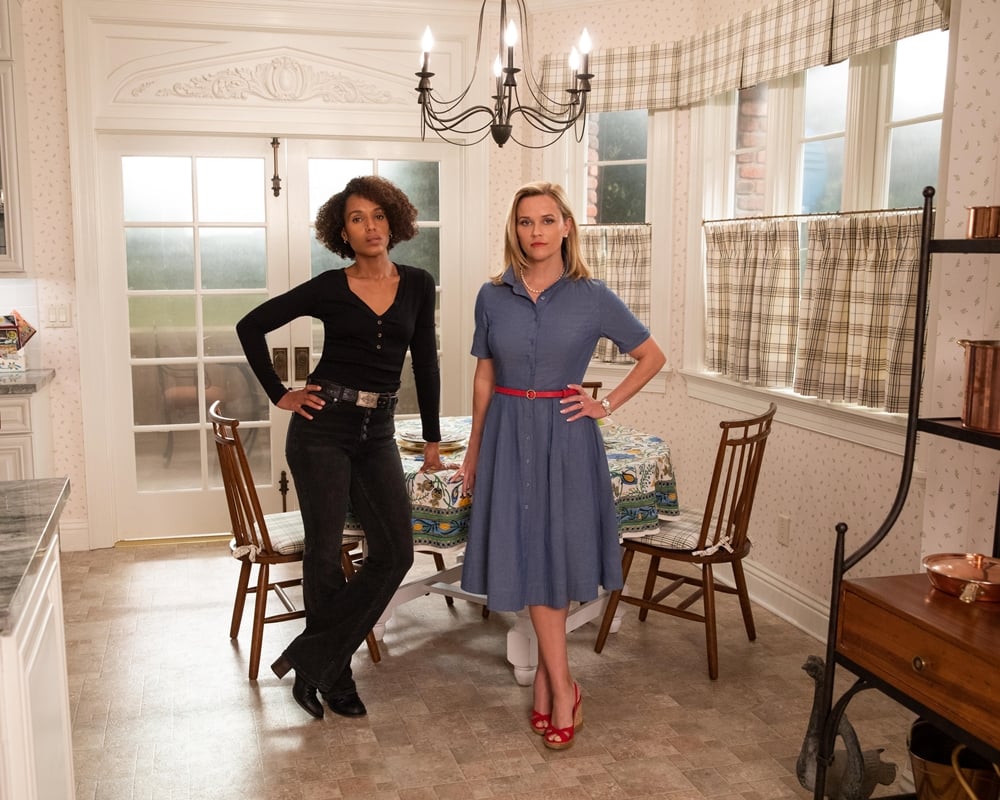
Which is why Ng herself knew that Witherspoon was the right person to head up the adaptation. Like Elena, and like Shaker Heights, Witherspoon’s star image is complicated. And as they began the development process, Ng’s belief was borne out; their first casting idea, outside of Witherspoon as Elena, was Kerry Washington as Mia Warren, the working-class artist who arrives in Shaker Heights with her daughter, Pearl, and ends up renting a duplex owned by the Richardsons. The plot of the book centers on various actions and reactions as the two families become intractably intertwined.
"You look at my face, and people tend to assume that I am not from here. There’s this visual othering."
In the book, Ng didn’t specify the Warrens’ race. She thought of the Richardsons as the established family, and the Warrens as outsiders — and, initially, she says, wondered if she should write them as nonwhite. “I knew I was invested in these questions of race and class,” Ng recalled. “And I had class in there [Mia is an artist and makes ends meet as a server at a local Chinese restaurant] and they literally come from outside of Shaker, and they behave differently. But then race, you look at my face, and people tend to assume that I am not from here. There’s this visual othering.”
But Ng didn’t want to make the Warrens Asian American, because it would make some of the later narrative tensions — involving the adoption of an Asian American baby — too neat. “I also didn’t feel like I was the person who could bring a black or Latina woman’s experience to life,” Ng said. But when Witherspoon and her coproducer, Lauren Neustadter, brought up the idea of casting Washington, Ng embraced it.
“I don’t want to do a J.K. Rowling and pretend that, all along, I had thought of this,” she told me. “I thought of her as a white character, but still exploring those larger issues of power. With Kerry, you have a way to explore the racial dynamics that I wasn’t able to explore in the book. And that, to me, told me that they were looking at the show the same way that I looked at the book. That they were going to look at these questions of power.”
Who has the power to set rules, and to discipline those who don’t follow them? As Little Fires Everywhere makes clear, it’s not just Elena Richardson — and the city of Shaker Heights — with their set of rules and punishments for those who don’t follow them. Mia, too, has rules for behavior, and whose she will and will not abide by. In the book, Mia is principled, but as portrayed by Kerry Washington, she is even more matter-of-fact, refusing to give the Richardsons the sort of comfort and assurance to which they have become accustomed.
“They told me, ‘Kerry’s playing Mia a little differently than in the book,’” Ng said. “And when I saw her do it for the first time, I was like, Oh, this is different! Most of the time, she’s much more reserved. But other times, the warmth is really there. I really liked that, and the way I read it was that this is a woman who does not feel the need to cater to the comfort of the more privileged people she’s meeting. It’s something I understand, and wrestle with, both as a person of color, and as a woman of color. So often we’re trained — or we learn, from necessity — how to make other people comfortable. And when other people are uncomfortable, because of how we respond, or something they’ve said, we just jump to the ‘oh, no, it’s okay!’ And Mia’s like, ‘I’m not going to do that anymore.’”
“In the beginning, you could read her as almost cold,” Ng continued. “Or hard. But as you keep watching, you see her in these different moments, and you realize: This has to do with who she’s talking to.” When Mia is talking with Elena, or Elena’s husband, Bill (played by Joshua Jackson), and their friends, she refuses to make small talk, or defuse awkward situations, or pretend the power dynamic inherent to living in a house the Richardsons own, cleaning and meal-prepping for them, doesn’t exist. Same for the two older Richardson children (Lexie and Trip) who’ve already adopted so many of their parents’ habits and self-righteous attitudes. But that demeanor changes when Mia is interacting with her coworkers at the Chinese restaurant, with her daughter, Pearl, and with the Richardsons’ youngest, misfit daughter, Izzy.
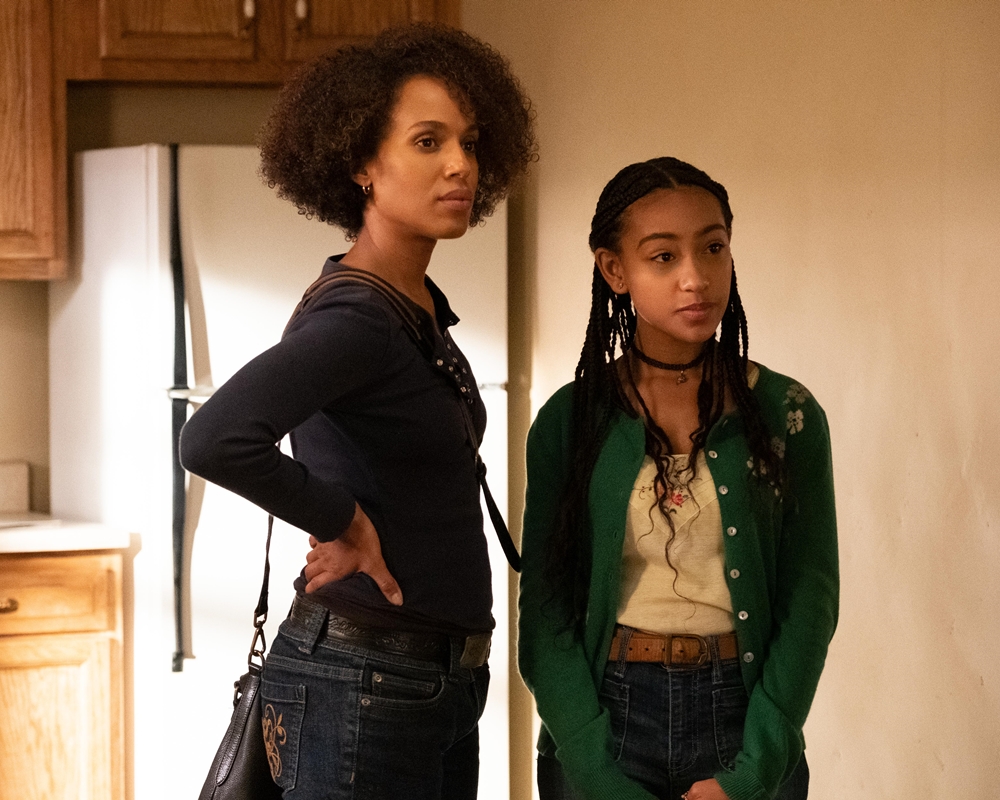
Kerry Washington in Little Fires Everywhere.
“I think people will see that difference — between Mia in the book, and Mia on the show,” Ng said, “and think, Huh, I wonder why they did that.” And that, to Ng, is one of the greatest pleasures and powers of adaptation: It encourages audiences to consider what’s lost, but also what’s gained, with each decision. Ng’s favorite adaptations are the ones that allow the text to say something different, or to illuminate a new angle: She loves Baz Luhrmann’s 1996 version of Romeo + Juliet for showing that the play “really is the story of some out-of-control teenagers who get in over their heads — and, like, to have Mercutio be high out of his mind in those early scenes, you’re like, Ohhhhh, that’s why he’s acting this way!”
"With Kerry, you have a way to explore the racial dynamics that I wasn’t able to explore in the book."
Most screen adaptations tend to make the source text less complicated. But Little Fires Everywhere does the opposite — and not just through the casting, and performance, of Washington. “In terms of racial landscape, I knew that the writers room needed to match the races of the mothers whose stories we were telling in the book,” showrunner Liz Tigelaar told me over the phone. Best known for her work on the Hulu series Casual, she set out to build a writers room diverse enough that there would be multiple experiences of being an adoptee, and navigating whiteness, and dealing with infertility.
“We had two writers with immigrant parents,” she continued, “We had writers raised by single mothers and single fathers. We had writers married to people who were of different races, and biracial children. And we had one father.”
“People challenged each other and were willing to be challenged,” Tigelaar continued. “And that’s what made the show great. People were able to say: ‘Being raised by a black mom is different from being raised by a white mom.’ And then when others say ‘how,’ you have a bunch of different people saying how their experiences were different, not just one person speaking for all black mothers and all black daughters.”
For Ng, the Elena backstory was particularly fascinating to watch unfold: It’s always curious to see options and choices other people map onto a character crafted in your own mind. In flashbacks, we see Elena grappling with confines of the life she chose for herself — including motherhood, especially after she learns she is (unexpectedly) pregnant with her fourth child — and her abject terror at just how unhappy she’s become. As Tigelaar explained, “With Elena’s backstory, you can see how someone can arrive at this point where they’re like, I had so many choices, and I’ve been choosing so carefully — so why do I still feel like all of these choices were made for me?”
“It gives you sympathy for her,” Ng said. “And you see how complicated she is, when she’s doing these horrible things and saying these horrible things about the other mothers” — including Bebe Chow, the Chinese immigrant who gives up her infant daughter when she can’t afford to feed her and whose desperate search for her becomes a pivot point in the novel.
The tragedy, then, is that the audience can see the similarities between what Elena went through, as a desperate parent of four small children, and what Bebe Chow also went through. But, even so, it’s so close to Elena that she herself can’t see. “Elena thinks, Well, I got out of it, and you didn’t, so the difference is that I must have tried harder and you didn’t,” Ng said. “She thinks it’s all about making good choices. But there’s this line that Kerry Washington has that’s so perfect: ‘You didn’t make good choices. You had good choices.’”
That line is new to the series, and one of many that Ng hopes will encourage a whole bunch of well-intentioned white ladies to feel even just slightly uncomfortable. Same for the casting of Witherspoon: She’s the perfect conduit to that audience. “The way Reese unravels the character of Elena is incredible,” Tigelaar told me. “There are moments when it gets so raw and so honest — a version of her that I don’t think we’ve seen on TV before, and a version that I think many well-intentioned people can relate to — that moment when you look up and you think, What did I just do? What did I destroy?”
“I love that Reese, one of America’s sweethearts, is like, ‘I’m going to let you watch me do something really terrible, and then work through whether or not you’re going to root for me,” Ng said. “Many of us are predisposed to give the benefit of the doubt to well-intentioned white ladies. And they’re used to getting that benefit of the doubt. I hope that people react to it the way that the show wants them to, which is to be reflective about that.”
Elena is not a clear villain. She’s not (explicitly) racist. She considers herself a liberal, though maybe not a feminist — a self-conception very much out of fashion in the late ’90s. But she’s like a lot of suburban white women: socially liberal, fiscally conservative. “Elena is such a Karen,” Ng said. “She totally wants to speak to your manager.”
“I love that Reese, one of America’s sweethearts, is like, ‘I’m going to let you watch me do something really terrible, and then work through whether or not you’re going to root for me.'”
Elena loves to bring up marching with Martin Luther King Jr. as a young girl (as she’s known to do at the dinner table) but thinks it’s rude, these days, to talk about race. “I don’t know [if the 2020 version of Elena] would be a Trump supporter,” Ng said. “But she might have voted for him.” Equally plausible: She might have voted for him, then showed up in a pink pussy hat at the Women’s March a few months later and worked to elect a Democrat to the House during the 2018 midterms.
Of course, there’s a risk that a whole lot of women will watch and think: I’m a well-intentioned white lady, but I’m not like that well-intentioned white lady. At book events, Ng often encounters women like this: They tell her they were from Shaker Heights, or from a place just like Shaker Heights, and knew women just like Elena. “To a person, they’d say, ‘I know an Elena,” Ng said. “‘But I’m not her.’ And that’s the thing: They can see it in other people, but they can’t see it in themselves.”
Ng is sympathetic: “I complain that my sister is turning into my mother, which she is,” she joked. “But I’m also turning into my mother, and I just can’t see it.” And she realizes as much. “Every car has a blind spot,” Ng continued. “It’s not the fault of your car. It’s not some sort of degradation of your car to say as much. But it means you cannot see in all directions. And if you hit something that’s in your blind spot, it’s still your fault. So if you know you have a blind spot, it’s really your responsibility to look, and check, and compensate for that blind spot.”
Look over your shoulder, in other words, or ask someone what you can’t see. But as the last few years have made clear, it can be incredibly difficult for people to listen as others outline exactly what those things might be. “I can see Elena at a Women’s March meeting,” Ng said. “And maybe she’d say something wrong — which she would, because she has blind spots — and it would be really hard for her to stop and shut up and listen. She’d be like, I’m trying, don’t get mad at me!”
“I certainly have blind spots — I want to be very up front about that,” Ng admitted. “But the best thing you can do is be very aware of them. And then you try and compensate. We tell this to our children, but we need to tell it to ourselves, too: It’s okay to not know something. But that is an opportunity to grow. You growing does not make up for the harm of the mistake. You try and make up for it, and you also try and be better.”
“All of these things are true at once,” Ng said. “Again, it’s complicated.”
Ng has used her vaunted position in the book world to speak out about the overwhelmingly white-dominated, white-oriented publishing system, which privileges white writers and white readers and also tends to tokenize writers of color. “On the one hand, being seen is so necessary and validating,” she told Publisher’s Weekly in 2018. “Those of us who haven’t had much representation know how important it is to see yourself on the page or on the screen. At the same time, being highly visible also has its downsides. Sometimes, when you’re seen prominently, you inadvertently end up blocking out other people. You’re often held up as the representative of your group, which is deeply problematic and something that I actively try to counter.” And she’s thought a lot about the question that currently consumes the industry: Who has the right to tell the story?
“I actually think that’s the wrong question,” Ng said. “Nobody has the ‘right,’ unless it’s their own personal story, to tell anything. I remember someone in my writing group once said, ‘You can do anything you can get away with.’ The question is what your intent is in writing the story. Did you do it right? And are you open to critique from people who maybe do know more about it than you do?”
With a book like American Dirt, which sparked an industry-wide uproar and reckoning for its apolitical, white gaze-y approach to the border crisis, these questions get knotty and difficult to address. Ng fears people will just give up before arriving at any sort of plan for systemic change. “It feels like the Three Stooges, with everyone knocking heads and falling on the ground unconscious,” she said. “I just really hope it starts actual conversations at the publishing houses, because [American Dirt author Jeanine Cummins] is allowed to write what she wants. But it is something to think about, when she gets a big push and other stories like that simply do not.”
"The question is what your intent is in writing the story. Did you do it right? And are you open to critique from people who maybe do know more about it than you do?”
The industry, as Ng sees it, is inherently conservative: It bets, and bets big, on what it knows, and what feels safe, and the sort of authors and target audiences that have performed well in the past. But it’s a self-fulfilling cycle; white writers writing for largely white audiences do well because the publishing houses put their weight behind them. And the reliance on white women, just generally speaking, leads to mistakes like American Dirt. “Systemic change is something that’s very difficult to do,” Ng said. “Especially from the bottom up. Authors talk about these things, and critics talk about these things, but it’s just not the same as coming from the top down.” And the top, at least right now, is still incredibly white.
Ng says she’s been additionally lucky in the industry to have not had to push back on well-intentioned attempts to make her, or her work, marketable. “My publicist is an Asian American woman, which is pretty rare. She’s of mixed Japanese and Chinese heritage, and understands the nuances of these situations. My agent is a white woman who is married to a black writer, and she has a mixed race son and stepdaughter. It’s great to just not, like, start at the bottom of the hill with trying to educate people on why books and stories like mine matter, or why we don’t want to do a story framed in a certain way. I get to start at least halfway up.”
And while Ng can’t provide that experience to every author, she does want to try to remake the industry for those coming up after her. Internships are the primary entry point for the publishing industry — but they’re still woefully underpaid. The industry itself does not collect or report its diversity stats. But according to an extensive survey, diversity numbers in internships are currently up, but most of the people who can afford to stay on with a low-paying junior editor position after the internship still come from backgrounds a whole lot like the people who’ve already made it in the publishing industry.
Inspired by the writer Shea Serrano, Ng is working with the organization We Need Diverse Books to fully fund two internships for at least five years for what the organization terms “people from diverse backgrounds.” “Because it’s not just a matter of getting more diversity of race, or gender expression,” Ng said, “but all the things.” The program will also set up mentorship programs with people already in the industry, in order to help prevent the sort of burnout that so often occurs as publishing employees attempt to navigate the white, bourgeois spaces of the industry.
“It’s so important to just have someone, or multiple someones, in the room who could say, maybe we shouldn’t do those barbed wire centerpieces,” she said, referring to the decorations at the American Dirt launch party. “It feels like an incremental approach, but maybe we can start here.”
At the end of our interview, Ng asked me if I knew how to get back to my hotel, and if we had talked about enough interesting things. She wasn’t being patronizing; it was just clear that she likes other people to be comfortable.
I wondered what other white women felt comfortable saying to her, after spending an hour with her at a book signing, or hearing her speak. Whether they ask her: How can I be better?
“They do,” she said, smiling knowingly. “But usually in the best way. After my first book came out — which includes so much about the sort of racism directed at a mixed Asian family — they’d say, ‘Oh, I’m so glad you wrote this book, because I didn’t realize that Asian people faced discrimination.’ And it would surprise me, but then, after a while, I’d be like, you know what? Good. I’m glad you know that now, because now you’re aware of something you weren’t aware of before. I’m really glad that it got you thinking about that. And I hope you carry that with you.”
In some ways, Ng said, people admitting that something you made or wrote or put in the world got them to think — even if it highlighted a massive knowledge gap or an implicit bias afforded by whiteness or some other privilege — is a compliment. Just a very complicated one.●
https://news.google.com/__i/rss/rd/articles/CBMicGh0dHBzOi8vd3d3LmJ1enpmZWVkbmV3cy5jb20vYXJ0aWNsZS9hbm5laGVsZW5wZXRlcnNlbi9saXR0bGUtZmlyZXMtZXZlcnl3aGVyZS1odWx1LWNlbGVzdGUtbmctcmVlc2Utd2l0aGVyc3Bwb27SAXBodHRwczovL3d3dy5idXp6ZmVlZG5ld3MuY29tL2FtcGh0bWwvYW5uZWhlbGVucGV0ZXJzZW4vbGl0dGxlLWZpcmVzLWV2ZXJ5d2hlcmUtaHVsdS1jZWxlc3RlLW5nLXJlZXNlLXdpdGhlcnNwcG9u?oc=5
2020-03-18 15:22:39Z
52780668946850